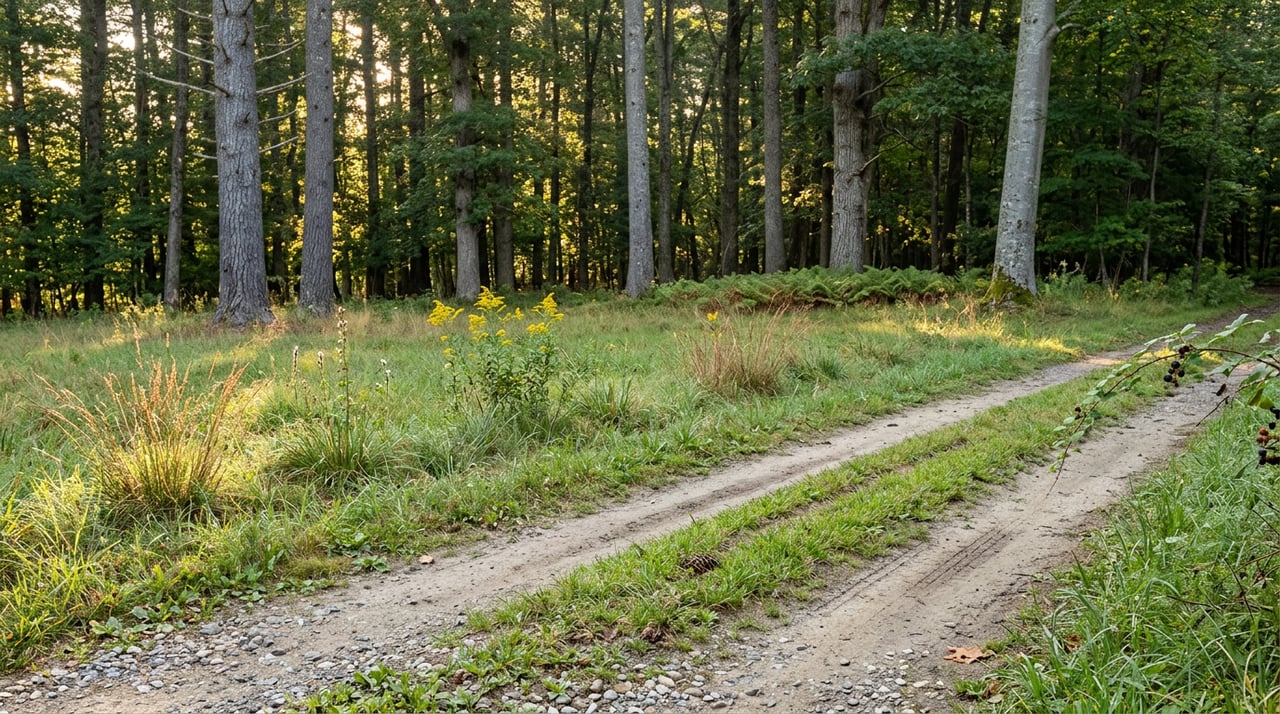
Picture two listings that land in your inbox the same week. Both sit within a few miles of downtown Kingsley. Both are wooded, both have road frontage, both are priced under $150,000. One is 4 acres. The other is 12. On paper, the 12-acre parcel looks like the obvious buy since it works out to a lower price per acre. Then your buyer's agent starts asking about the well, the septic, and how many lots the county will actually let you cut from each one, and the math stops looking so simple.
That gap between what a listing sign says and what a parcel can legally become is the whole story right now for anyone shopping raw land around Kingsley. Price per acre is the number everyone anchors to, and it is quietly one of the least reliable numbers in this market.
The Number Everyone Compares, and Why It Bends
Land near Kingsley does not price out evenly, and the spread is wide enough to change a buying decision. Active listings for undeveloped, vacant parcels near Kingsley have been running around $12,562 an acre on average across roughly 79 properties as of August 2026. Move into the broader category of "land for sale," which mixes in smaller in-town lots and higher-traffic parcels, and the average climbs to about $26,970 an acre across 151 listings. Larger rural and recreational tracts, the 20-, 40-, and 80-acre hunting and hobby-farm parcels, average closer to $29,999 an acre. Parcels that already have a house sitting on them jump again, averaging roughly $55,135 an acre.
Four categories of land, four different per-acre numbers, all within a few miles of the same village center. A buyer who treats "price per acre" as a fixed yardstick will misread every one of those listings.
| Land type near Kingsley | Avg. listing price | Avg. price per acre |
|---|---|---|
| Undeveloped/vacant land | $121,752 | $12,562 |
| All land listings (blended) | $232,955 | $26,970 |
| Rural/recreational tracts | $258,592 | $29,999 |
| Houses with land | $424,584 | $55,135 |
The pattern is not random. Smaller parcels and improved parcels cost more per acre because you are not just buying dirt. You are buying proximity, access, and in the case of a house, a structure that already cleared every hurdle a raw lot still has to clear.
The Friction That Actually Sets the Price
Every acre near Kingsley that does not already have a house on it still has to prove it can support one, and that process has a price tag attached before you ever break ground.
Grand Traverse County requires a well and septic evaluation as part of due diligence on most vacant parcels, and the Grand Traverse County Health Department can take up to 30 days to turn around a site evaluation once you apply. The county's fee schedule lists a residential septic permit for new construction at $525, a combined septic and well evaluation at $300, and an extra $150 charge specifically for land divisions under one acre. If you are dividing land into new parcels using a metes-and-bounds description rather than a formal plat, each resulting parcel gets billed as its own site evaluation, up to a minimum development fee currently set at $1,500.
Then there is the road. Any proposed land split near Kingsley also has to clear a separate review from the Grand Traverse Road Commission, which checks sight distance for safe access under a 1996 state law before the township will approve the split. That review typically takes another 7 to 10 business days and runs independently of any driveway permit you'll also need.
None of this shows up in a listing photo. It shows up in a closing timeline, and it is a big part of why the smallest, cheapest-looking parcels are not automatically the best value. A 2-acre lot priced low per square foot can still cost you weeks in permitting and a five-figure well-and-septic bill before it is buildable, while a larger tract with an existing perc test on file might be ready to go.
The Law That's About to Rewrite What "Buildable" Means
Here is the part of this market that most buyers comparing Kingsley listings right now have not priced in yet.
Michigan's Land Division Act has long capped how finely a landowner can slice a parcel without going through full subdivision platting. Under the rule that has governed splits for years, the first 10 acres of a parent parcel could be divided into no more than four resulting parcels. That cap shaped how Grand Traverse County acreage got carved up and sold.
That changed under Public Act 58 of 2025, signed in December 2025, which amends Section 108 of the Land Division Act. The law itself took effect March 24, 2026, but the expanded splitting rights are phased in over a full year rather than arriving all at once. During that transition, the old four-parcel cap still applies statewide by default unless a specific township opts in early with its own ordinance. According to a legal analysis from Varnum LLP, this is "the first revision to the LDA framework in nearly three decades," and the expanded cap of up to 10 parcels from the same first 10 acres does not become the statewide default until March 24, 2027, more than doubling what a landowner could split from that acreage under the old rule.
There is a wrinkle worth understanding if you are evaluating Kingsley-area acreage specifically. Beginning March 24, 2026, local townships and the county gained the authority to adopt their own ordinances that override the state default, either tightening the cap or loosening it further. That means the actual number of lots a given Kingsley-area parcel can yield depends on what the surrounding township decides to do with that authority over the next several months, not just on the state's default schedule. A 10-acre parcel that qualifies for four lots today could legally support ten by 2027, assuming the local township does not adopt a stricter local standard first.
For an investor pricing raw acreage today, that is not a footnote. It is the difference between valuing a parcel as one future home site and valuing it as several.
Kingsley Just Told the State It's Ready for This
The timing lines up with something specific to Kingsley itself. In May 2026, the Michigan Economic Development Corporation certified the Village of Kingsley as a Redevelopment Ready Community, joining a group of 92 Michigan communities the state considers "thoroughly prepared" in their planning and zoning practices. Village President Mary Lajko called it "a significant milestone for the Village of Kingsley."
The RRC designation does not rezone anything or guarantee approval for any specific project. What it signals is that the village has already done the groundwork on clear, predictable development review, which matters directly to anyone weighing a land split or small infill project inside village limits versus out in the surrounding township. A developer working through the Village of Kingsley's planning and zoning process now has a certified, standardized review path to work from, at the same moment the state is loosening how many parcels can come out of a given piece of ground.
Two separate signals, arriving the same year, both pointing the same direction: the regulatory friction that has kept Kingsley-area land pricing conservative for the smaller parcels is easing, not tightening.
What This Means If You're Actually Shopping Land Here
Put the pieces together and the practical read for a buyer or investor looking at Kingsley acreage this year is this. The listing price per acre tells you what a parcel costs today under the old split rules and today's permitting friction. It does not tell you what that same parcel might be worth once the split cap fully phases in by March 2027, or what a local township ordinance might do to that math sooner.
Before making an offer on raw acreage near Kingsley, it is worth asking a few concrete questions:
- Has a septic and well site evaluation already been completed, or will that cost and the 30-day wait fall on you after closing?
- What is the parent parcel's current split history, and how many additional divisions would be available under both the current cap and the 2027 cap?
- Has the surrounding township signaled whether it plans to adopt its own division ordinance under the new local override authority?
- If the land sits inside village limits, does the RRC-certified review process change your permitting timeline compared to the township?
None of those questions show up in a per-acre price. All of them change what that price actually buys.
A Few Common Questions
Does the new split-cap law apply to land I already own, or only to new purchases? The amended Land Division Act applies to how any parcel can be divided going forward, based on its status as a parent parcel, not on when you purchased it. Existing owners gain the same expanded division rights as new buyers once the relevant phase takes effect, subject to whatever local ordinance the township has in place at the time.
Do I need a septic evaluation if I'm buying vacant land with no house on it? Grand Traverse County typically requires a site evaluation for septic suitability as part of due diligence on vacant parcels, separate from the county's Time of Transfer rule that applies when an existing home with a septic system changes hands. Budget for that evaluation and its turnaround time before you assume a parcel is buildable.
Who handles my land-split application, the township or the county? Both, in sequence. The Grand Traverse Road Commission reviews proposed splits for safe road access before the township will approve the division, and the county health department separately evaluates septic and well feasibility. Plan for both reviews when you're timing a purchase around a planned split.
Land math near Kingsley is changing on two fronts at once this year, and the parcels that look expensive per acre today are not necessarily the ones that stay that way. If you are trying to figure out what a specific piece of Kingsley-area ground is actually worth once you factor in septic feasibility, split rights, and where the local township stands on the new override authority, Joe Van Antwerp has spent years walking these parcels and these permitting offices. Contact Joe for a free consultation before you make an offer based on the number on the sign.
